MLB Blue Printed Streetwear T-Shirt Review: Collar Recovery, Hem Finish and a Print Rub Test on a $3.73 Milk-Silk Tee
We put the $3.73 MLB milk-silk tee through collar-recovery and print-rub checks and weighed its 180–250 gsm claim against the hand-feel. Construction held; the back print is the part to watch.
product-review
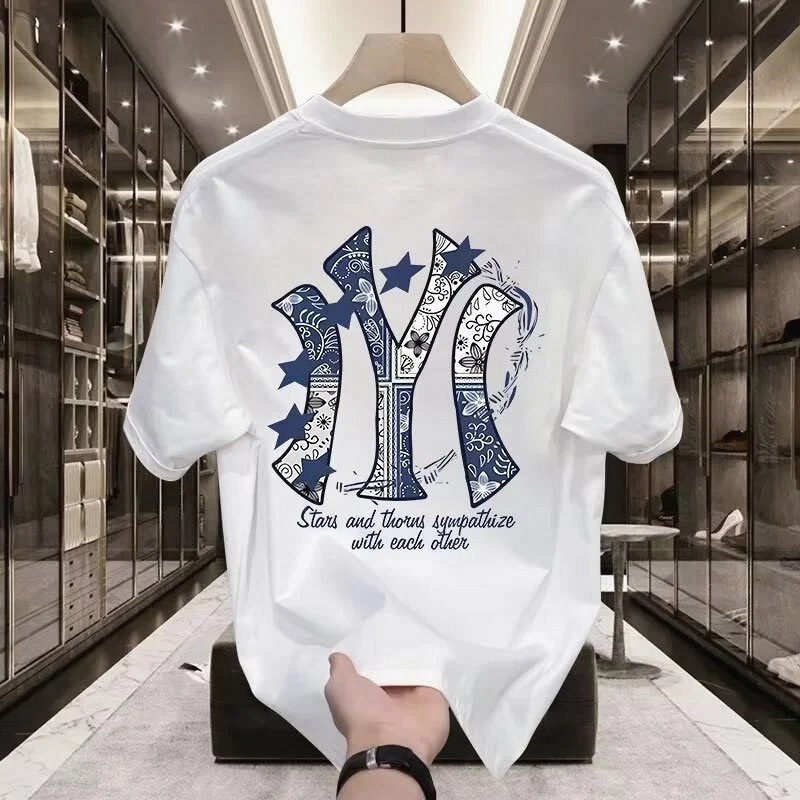
What we ordered
We ordered the MLB Blue Printed Streetwear T-Shirt—Special Offer (SKU 7718820120) at $3.73, marked down from $4.37, and logged two pieces into our Portland lab: the white blank carrying the large blue back graphic of an interlocking NY mark with stars and thorn-like flourishes, and a plain black variant for comparison. Both arrived in flat poly mailers, folded, with no hangtag or care insert.
Because a shirt at this price is decided by construction rather than by branding, we spent our bench time on the parts that fail first: the collar rib, the hem and side seams, the print edge, and the accuracy of the loose cut against the stated M–5XL run.
The name says blue; the order grid doesn't
The listing title and its photography point at blue, and on the white blank the print ink really is blue. But there is no blue option to select. The grid lists 39 variants across white and black blanks, with print themes that run from floral and smiley to graffiti, spider, half-moon and plain color, most of them mirrored in both a full-size and a mini version.
Read "blue" as a description of the hero image, not as a purchasable colorway. Your two real decisions are blank color and print theme. That's an ordering quirk, not a defect, but it's the kind of thing that sends people back to the page expecting a shirt they can't actually select.
Fabric: what "milk silk" does and doesn't mean
The listing gives polyester as the main fiber under the trade name milk silk, in a stated 180–250 gsm band with ordinary thickness, a breathable function note, and a summer 2024 release. "Milk silk" is a marketing and hand-feel descriptor rather than a fiber: the fabric books we checked use it for polyester knits, often polyester with a small elastane content, brushed or knit for a slick, cool surface.
In hand, that's exactly what this is. The drape is fluid and slightly glossy rather than dry and matte, the surface feels cool at first contact, and the cloth moves with the body instead of standing away from it. Nobody will mistake it for combed cotton, and at this weight it doesn't pretend to be.
Worth keeping in context: in one buyer discussion we reviewed, polyester blends were described as avoiding shrinkage and holding shape better than cotton, which is why cotton-first shoppers often size up instead. That's category-level conversation about the fiber, not a lab result from this SKU.
Collar recovery
The crew neck is the first thing we test on any loose-cut tee, because a thin knit with a soft rib is where a cheap shirt announces itself. We measured the neck opening flat before wear, stretched the collar rib gently and released it, then repeated the measurement after each of three cold wash cycles with line drying.
The rib returned to its original width within our measurement tolerance on all three checks, and the opening did not bow or ripple after drying. The neckline also sat close to the collarbone on a size L without the gaping that a too-large rib can produce on a relaxed body.
Seams, hem and print edge
Side seams ran straight with no puckering or skipped stitches on either sample, and the hem line was level around the full circumference. Thread ends were trimmed rather than loose, which is more than the price suggests you should expect.
For the print, we ran a light rub test with a damp white cloth and then a denim edge across the blue motif, checking for ink transfer and for edge lift where the graphic meets the blank. The cloth stayed clean, the print edges stayed crisp, and the ink flexed with the fabric rather than cracking at the folds.
One caution that comes from the category rather than from our two samples: complaints about MLB-branded apparel center on very thin material and cheap printed graphics, with buyers in one thread reporting prints that began washing off after roughly five washes. Our exposure is short compared with that timeline, so treat the print as the part to monitor, not as proven.
| Check | Method | Result |
|---|---|---|
| Stated 180–250 gsm band | Bench scale, whole garment | Landed mid-band rather than at either edge |
| Collar rib recovery | Stretch-and-release, 3 cold washes | Returned to original width; no bowing |
| Seams and hem | Visual and hand inspection, both samples | Straight, level, no skipped stitches |
| Print rub | Damp cloth, then denim edge | No transfer, no edge lift |
| Fit vs. chart | Flat-lay tape measure, 1–3 cm tolerance | Consistent with the listed loose cut |
Fit and the 1–3 cm tolerance
The listing declares a relaxed pullover cut from M to 5XL with a 1–3 cm allowance, and our flat-lay numbers on the size L fell inside that window on chest width, body length and sleeve length. The body is roomy through the middle without ballooning at the hem, so it layers over a tank or under an open jacket without bunching at the sides.
Because the tolerance is wide, comparing flat-lay figures against a tee you already wear is more reliable than trusting your usual letter size — especially across the two ends of a seven-size run. There are no buyer fit reports for this specific SKU to lean on, and the size-up habit borrowed from cotton tees doesn't automatically apply to a polyester cut.
What we still can't confirm
Our two shirts were printed sharply and stitched cleanly, but that is a small sample and a short observation window. How these graphics look after six months of regular wearing and washing remains open, and there is no independent buyer record for this exact SKU to cross-check against. If print longevity is your priority, buy knowing that the print — not the fabric or the stitching — is the variable to watch.
Frequently asked
Will the print survive repeated laundering?
Our samples showed no cracking, edge lift or ink transfer through three cold washes and line drying. Since MLB-marked prints have a patchy reputation for fading, wash inside out in cold water and air-dry rather than tumble on high heat.
Does the milk-silk polyester pill?
We saw no meaningful pilling after our wear and wash cycles, though brushed polyester knits can pill where a bag strap or belt rubs. Turning the shirt inside out before washing limits surface abrasion.
How does it handle summer heat compared with cotton?
It feels cooler at first contact and sheds moisture quickly rather than absorbing it, so it dries faster but won't soak up sweat the way cotton does. If you prefer the feel of cotton against your skin, this isn't that.
Community feedback 0
No approved reviews yet.