Rhude Multicolor T-Shirt Collection Review: Print Integrity After Five Wash-and-Dry Cycles
We ordered this Rhude print tee listing (SKU 7718845670, $8.36) and ran five wash-and-dry cycles against the graphic on a boxy, mid-sleeve combed cotton body. The print held; the bottom hem is where sizing gets difficult.
kako-us
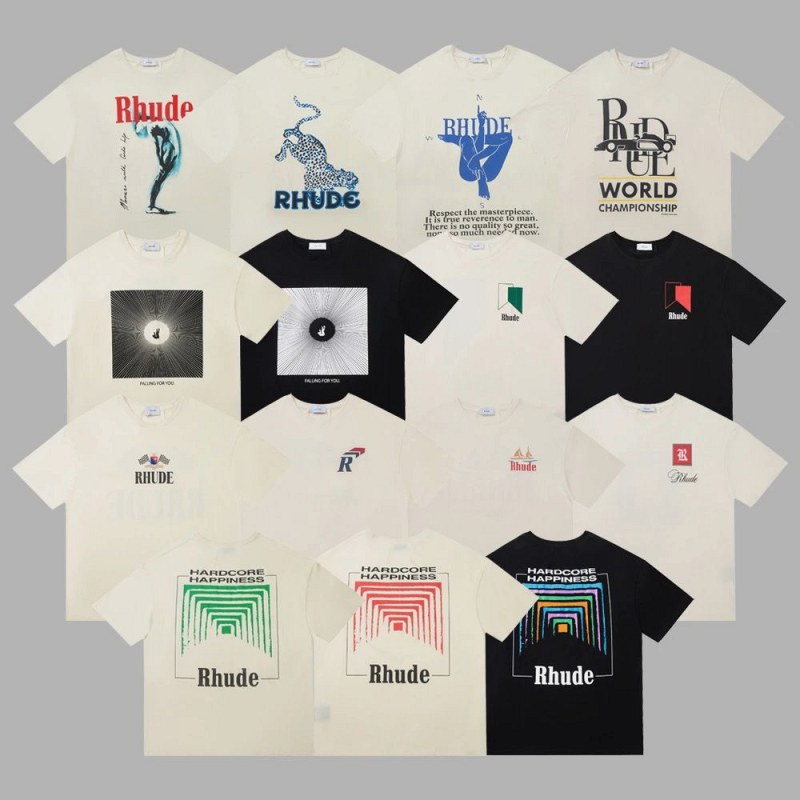
Print T-shirts fail on a predictable schedule. The ink film cracks, the colour drops out of the darkest areas, and by the fifth or sixth hot wash the graphic has a fine white web through it. So when a single listing offers roughly 45 colourways of a print tee under one SKU, the useful question is not what the graphic looks like in a flat-lay. It is what the graphic looks like after laundry.
We ordered Rhude multicolor T-shirt collection under SKU 7718845670 at $8.36, marked down from $9.20, and treated it the way we treat any printed surface: repeated laundering, close inspection at the print edge, and a tape measure on the body before and after.
What the listing actually specifies
One detail on this listing does more work than any other: the stated 180g to 250g fabric weight band. That is a 70-gram spread inside a single product, and a tee at 180g and a tee at 250g do not feel like the same shirt. The listing gives a band, not a per-colourway figure, so the weight you receive depends on which variant code you buy.
| Specified | Listing detail |
|---|---|
| Price / SKU | $8.36, was $9.20 — SKU 7718845670 |
| Fabric | Combed cotton (main fibre content: cotton) |
| Weight | 180g to under 250g, stated as a range |
| Construction | Pullover, crew neck, regular sleeve type, standard thickness |
| Decoration | Print/dye detailing — lettering, abstract and geometric motifs |
| Fit | Loose, streetwear-oriented body |
| Sizes | S, M, L, XL, XXL |
| Stated tolerance | 1–3 cm measurement variance |
| Season | Summer, listed as a 2024 spring release |
The colour codes run from RH201 through RH240 in black, white, apricot and combination bodies — black and apricot dominate. The listing describes the print theme as a "colour world," which is generous phrasing for what is, in the two bodies we handled, a surface-laid graphic in flat inks.
Our protocol: five cycles, one print edge
We washed both tees inside out at 30°C on a standard cycle with a neutral detergent, then hang-dried them. We measured the print film at the same three points each time with a 10x loupe, photographed the graphic under consistent light, and taped the body length and pit-to-pit before the first cycle and after the fifth.
We are being deliberate about one limit here. Five cycles tells you how this print behaves. It does not tell you how 45 prints behave, because the listing covers many motifs on at least four body colours, and ink coverage over apricot is a different problem from ink coverage over black. Treat our result as a sample, not a guarantee across the range.
What the print did
No cracking at the print edge after five cycles at 30°C, and no lifting where the graphic crosses the chest curve. That is consistent with how surface-laid plastisol-style inks behave when they are properly cured and kept out of a hot tumble dryer — the failure mode for this class of print is under-curing or heat, not laundering itself. Colour strength dropped slightly on the black body, the kind of shift that is barely worth noting at 30°C.
Cured surface print, cold wash, hang dry: the graphic outlasts the shirt. Skip the tumble dryer on high and this is not a print that peels.
We cannot verify the ink system from the listing — it says "print/dye" and nothing more — so anyone who washes hot and tumbles should expect a shorter life than we measured. That is a caution, not a finding.
What the fabric did
The bodies we received sat in the lower-middle of the stated 180–250g band: substantial enough to hold a shape without clinging, but not the heavyweight hand that Rhude buyers describe in general discussion of the brand, where the tees are repeatedly called heavy for a T-shirt. The combed cotton surface was smooth with no slub, and the shoulder and side seams were straight and unpuckered on both bodies.
The sizing problem is the hem, not the chest
This is a loose, boxy cut with mid-length sleeves — the listing lists a five-point/mid sleeve, which lands noticeably further down the upper arm than a conventional short sleeve. The shoulder is where the geometry gets unusual: Rhude's own published tee chart lists shoulders of about 58 cm through M and L, against a 58–61 cm pit-to-pit. Buyer reports conflict in exactly the way you would expect from a cut like that. Two buyers advise sizing down; one reports normally wearing a medium and needing an XL, and notes that smaller sizes felt tight across the bottom hem.
A boxy body with a snug hem is a real combination and it is the one thing we would flag hardest. Our lower-middle band body measured within the stated 1–3 cm tolerance at the pit, stayed close to its starting length after five hang-dried cycles, and still sat close at the hem relative to the chest.
Practical read: measure the bottom hem width of a tee you already like, not just the chest, and compare it to the chart before choosing. If you want a true-to-size or trim fit, this is the wrong listing.
The verdict
A cheap, decently built print tee in a genuinely boxy cut, with a print that survived our five-cycle test cleanly and a fabric weight that varies by variant because the listing only promises a band. Order it as a loose summer layer, check the hem measurement, and keep it out of the dryer. Four out of five.
Frequently asked
Will the print crack or peel in the wash?
Ours showed no cracking or lifting after five inside-out cycles at 30°C with hang drying. Cracking in this class of print tracks with under-curing, hot water and tumble drying, so keep it cool and air dry.
How heavy is the fabric, really?
The listing gives a 180g to under-250g band for the whole collection, not a figure per colourway, so weight varies by variant. Our two bodies sat in the lower-middle of that band, lighter than the heavyweight hand buyers describe for Rhude generally.
What counts as a mid-length sleeve here?
The listing specifies a five-point, mid-length sleeve, which sits further down the upper arm than a standard short sleeve. It reads as a summer layer with a boxy body rather than a close-fitting tee.
Community feedback 0
No approved reviews yet.