Nike Winter Commuter Shoe Review: Uppers, Soles & QC
 Caption: Screenshot of fashion-reps' Nike brand page, useful for checking product titles, reference prices, categories, and QC entry points before ordering. ## What specific buying problem this review solves This article solves one specific problem: after seeing [Nike shoes](https://fashion-reps.net/shoes/nike) on fashion-reps, how winter
general
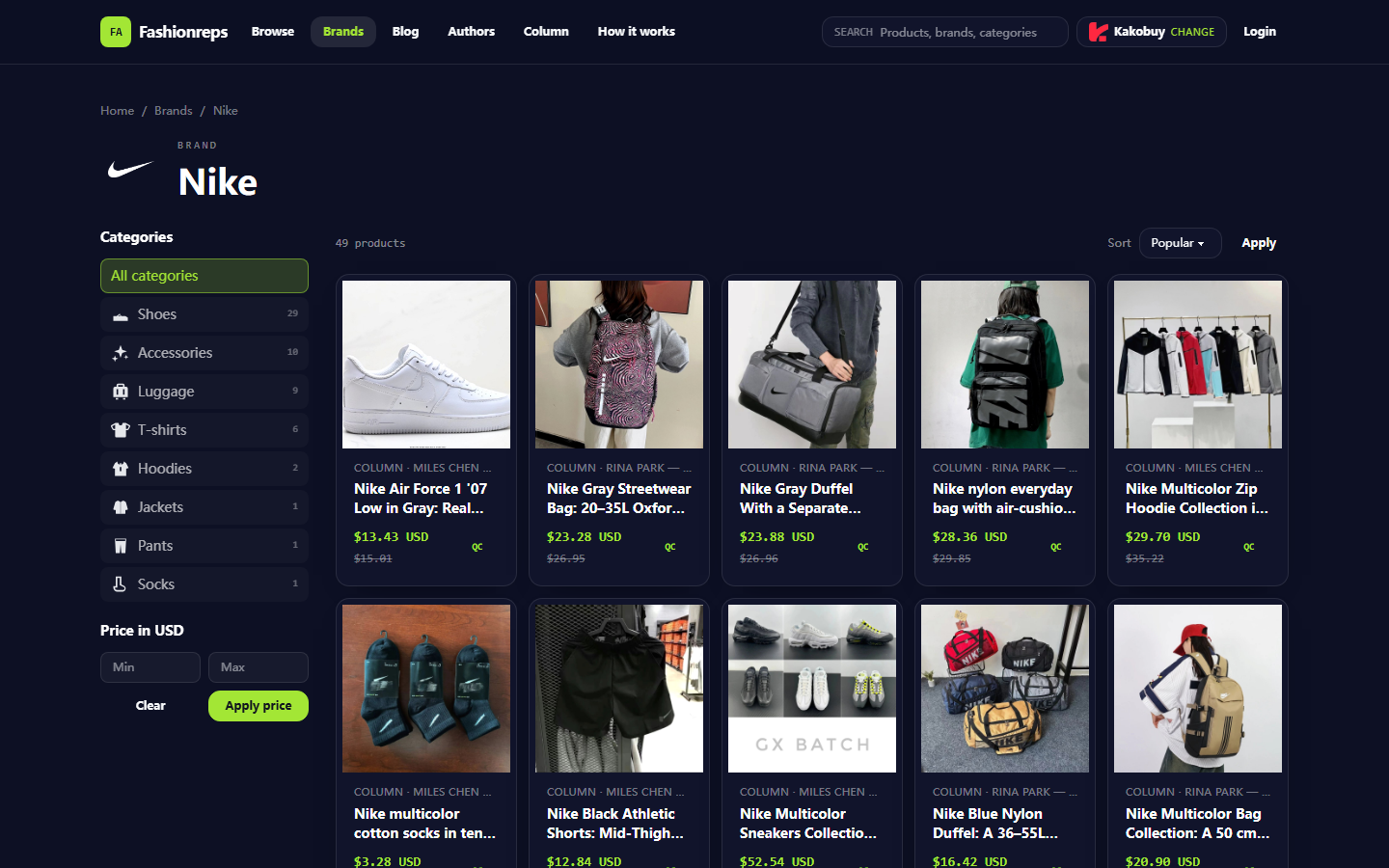

Caption: Screenshot of fashion-reps' Nike brand page, useful for checking product titles, reference prices, categories, and QC entry points before ordering.
What specific buying problem this review solves
This article solves one specific problem: after seeing Nike shoes on fashion-reps, how winter commuter buyers can use the visible information on the product page and subsequent QC photos to decide whether the shoe is worth continuing to order, seeking additional evidence, or giving up.
It does not judge whether the shoe is authentic, does not provide brand authenticity guarantees, and does not treat community popularity as proof of quality. This article is for buyers who are already prepared to view, order, and have items inspected through agent platforms; if you are looking for professional athletic performance shoes, snow boots with slip resistance, extreme cold weather boots, or need official after-sales support, these fashion-reps product pages are not the most reliable starting point.
Verification date for this article: October 8, 2026. Page screenshots show that fashion-reps' Nike brand page has 49 products, with 29 shoes, and the Buy button jumps to the corresponding agent platform based on user selection. The visible reference prices, previous reference prices, sizes, material descriptions, and product quantities are all information that may change, and should be re-checked before ordering.
Which Nike shoe information to check first on fashionreps product pages
After entering the Nike brand page, don't be led by style images or prices first. For winter commuter shoes, the first thing to look at is whether the product title can answer three questions: what is the shoe model, what is the upper material, and whether the size range covers the foot length or usual size you need.
In the screenshot sample, you can see several types of Nike shoe information related to commuting: low-top sneakers, Dunk-style low-tops, Air Force 1-type shoes, classic athletic silhouettes with thick rubber outsoles, and some product titles that explicitly state leather upper, split-leather upper, platform midsole, half-size run, etc. The point here is not to remember a specific product, but to treat the title as the first layer of evidence.
Before ordering, it is recommended to check in this order:
- Whether the product is still accessible on the Nike brand page or in the shoe category filter results.
- Whether the title clearly states the upper material, such as leather, split leather, suede, mesh, or unspecified.
- Whether the title specifies low-top, mid-top, lace-up, platform, etc., which affect winter commuting.
- Whether the reference price still exists and confirm the currency is USD.
- Whether the size range covers your target size, especially half sizes, EU 35-45, or other ranges.
- Whether there is a QC label or access to subsequent inspection processes.
If the product page only gives a vague title, no clear material description, no size range, and no subsequent QC photos to rely on, it is not suitable to buy directly as a "winter commuter shoe." ❄️
Which details on upper, lining, and outsole can serve as page evidence
Winter commuter shoes are not just about "looking good." Urban commuting often involves low temperatures, wet ground after rain, subway stairs, office air conditioning, long periods of standing, and all-day styling. The most useful evidence on the product page is concentrated on the upper, lining, outsole, and shoe structure stability.
For the upper, if the title or product information explicitly states leather upper, split-leather upper, suede, or mesh, you can initially judge the applicable boundaries. Leather or split leather is generally more suitable than large areas of mesh for daily roads after cold wind and light rain, but you also need to look at creases, stitching, and leather surface smoothness in QC photos. Suede is visually more suitable for fall/winter styling, but has higher maintenance costs when wet. Mesh shoes are more breathable, may be too cold for winter commuting, and are more likely to let rain or dust in.
For the lining, if the page only says ordinary athletic shoes or street shoes, it should not be automatically understood as insulated shoes. Unless the page explicitly states fleece lining, plush, sherpa, or other lining materials, it should be treated as a regular lining. Even if the title includes "winter" or the seller's promotional images show thick clothing, that cannot replace material evidence.
For the outsole, you can prioritize information like thick rubber outsole, platform midsole, low-top lace-up, forefoot strap, etc. A thick rubber outsole may improve durability feel and ground insulation, but does not equal slip resistance certification; a thick sole may also change foot feel, center of gravity, and pant hem styling. For wet and slippery ground in winter, you need to check the tread depth, sole edge, outsole bonding, and left-right sole symmetry in QC photos.
| Visible evidence | Significance for winter commuting | Additional evidence still needed |
|---|---|---|
| leather upper or split-leather upper | Better than large mesh areas for cold wind and mild damp conditions | QC photos to confirm leather smoothness, stitching, and toe shape |
| thick rubber outsole | May improve wear resistance and ground insulation | Sole tread, glue marks, left-right height consistency |
| low-top sneaker | Wide styling range, suitable for office and daily commuting | Low-top does not keep ankles warm, limited protection in rain/snow |
| platform midsole | Visually heavier, suitable for wide or straight pants | Center of gravity, weight, and sole bonding need QC review |
How to judge styling boundaries for fall/winter commuting scenarios
If your commute route mainly involves subway, bus, office, and short walks, a low-top Nike-style shoe is more like a "fall/winter daily shoe," not a serious outdoor winter boot. Its advantage is easy styling: black, grey, white-black colorways, brown, or mocha usually pair well with jeans, cargo pants, sweatpants, and straight-leg casual pants.
But the boundaries are also clear. Low-top shoes are not suitable for prolonged rain/snow, standing water, or work environments requiring slip resistance certification. White or light grey uppers have higher maintenance costs in winter mud and water; suede and light-colored mixed materials require more caution. Platform shoes suit wide pants, layering, and street silhouettes, but if you walk up and down many stairs daily, a sole that is too thick or stiff may be more tiring than a regular low-top.
A more practical way to judge is to place the shoe into your actual commute route:
- Walking less than 30 minutes daily, dry roads, mainly office environment: low-top leather or split leather shoes can proceed to QC.
- Frequent rain, slippery roads, need to climb stairs: prioritize sole detail photos, not just front and side views.
- Need to style with long coats, down jackets, and wide pants: dark colors, grey, brown, or mocha are more hassle-free than large areas of pure white.
- Need to stand all day: don't just look at appearance, must confirm sole thickness, insole, and size allowance.
- Need warmth: unless the page explicitly states lining material, don't treat ordinary athletic shoes as winter boots. 👟
Checklist for rechecking size, color, specs, and link status
The reference price and product title on fashion-reps pages are only entry points; before actually ordering, you should recheck on the agent platform or original product link after jumping. The screenshot shows that the Buy button jumps according to the selected agent platform, for example, Kakobuy is displayed as the current selection; this indicates that the actual purchase path for the same product may be affected by the platform chosen by the user.
Before ordering, it is recommended to recheck item by item:
- Link status: Confirm that the product detail page, agent platform page, or original product link still opens, not 404, blank page, redirect to irrelevant page, or only category page.
- Title consistency: The fashion-reps title, agent platform title, and product detail information should correspond to the same shoe.
- Color options: Confirm that color names, images, and SKUs do not conflict, especially for similar options like black-white, grey-white, mocha, brown.
- Size range: Confirm whether your target size is available, whether half sizes are supported, and whether you need to choose based on EU size or foot length.
- Material description: When the page states leather, suede, mesh, or cotton, confirm whether it refers to the upper, lining, or other parts.
- Price and shipping: Reference price is not final cost; also calculate agent service fees, domestic shipping, international shipping, warehousing, consolidation, and possible taxes.
- Return/exchange window: Confirm whether the seller or agent platform supports returns/exchanges, and whether issues found after warehousing can still be handled.
If any of these cannot be confirmed, the most reasonable action is not to guess, but to save the link, screenshot the current page information, and wait for QC photos or ask the agent platform for clarification.
Which visible issues to check first in QC photos
QC photos are key evidence for whether such shoes should be shipped. They cannot prove authenticity or long-term durability, but can help you spot obvious workmanship, colorway, size, and left-right differences.
It is recommended to check 8 positions first:
- Toe: Whether left and right toe shapes are consistent, whether the upper is collapsed, bulging, or clearly uneven.
- Side: Whether stitching is crooked, and logo positions are consistent left and right.
- Heel: Whether heel height, heel stitching, and heel tab are symmetrical.
- Tongue: Whether tongue length, label position, and proportion exposed above laces are consistent.
- Sole sidewall: Whether glue marks, excess glue, separation, dirt, and edge lines are obvious.
- Outsole: Whether tread is clear, with no abnormal wear, deformation, or dirt.
- Internal labels and size: Whether left and right sizes are consistent and match your order options.
- Accessories: Whether shoebox, laces, hang tags, or extra accessories match the page description.
The most common mistake in QC is only looking at the first photo from the prettiest angle. For winter commuter shoes, especially check the sole and heel, because these two positions determine walking stability and whether issues are easily exposed by pant hems, rain, and stairs. 🧾
What community feedback can indicate, and what it cannot prove
fashionreps-related community discussions can provide useful signals, such as whether a certain shoe is often asked about sizing, whether a seller recently shipped wrong colors, or whether a type of sole is complained about being too hard. But community feedback cannot directly prove that a specific link, a specific batch, or the pair you are about to receive has no problems.
A more reliable use is to treat community feedback as a question list, not a purchase conclusion. For example, if you see multiple people discussing that Nike low-tops run small, go back to the product page and QC stage to focus on confirming size; if someone mentions a hard outsole, request specific angles of the sole side and bending after warehousing; if someone posts pictures saying the color is too grey, check whether the seller's images, product options, and warehouse actual photos match.
Do not treat these expressions as factual evidence:
- "Many people buy it" does not mean it suits your commute route.
- "Looks authentic" does not mean authentic or risk-free.
- "Seller is reliable" does not mean the current link, current batch, and current size are all reliable.
- "Can be worn in winter" does not mean waterproof, slip-resistant, or warm.
The value of the community is to help you discover what to ask, not to do the verification for you. 🔍
Two situations: suitable to continue ordering vs. needing more evidence
Situations suitable for continuing to order usually share several common points: the product page is still accessible, the title and jump page information are consistent, the upper material has a clear description, the size range covers your needs, color options are clear, the price is within your budget, and you are willing to use photos at the QC stage for final judgment. Such shoes are more suitable for daily commuting, short walks, and fall/winter styling, not as extreme weather gear.
Situations that need more evidence or a pause are also clear: no material description on the product page, inconsistent title after jumping, vague size options, color images and option names not matching, reference price changes too much, or insufficient QC photos available. Especially for platform soles, suede, light-colored uppers, and high-priced shoes, you should confirm details after warehousing before deciding to ship.
Ultimately, weigh savings against risk. A low reference price may offer a budget advantage, but you still bear agent service fees, international shipping, communication costs for returns/exchanges, size mismatches, unsatisfactory QC, customs duties, and after-sales uncertainty. For commuter shoes, what is truly worth continuing is not "cheapest," but "sufficient information, controllable risk, and scenario match."
| Decision | Suitable for | Main benefit | Increased risk | Conditions not recommended |
|---|---|---|---|---|
| Continue order and wait for QC | People who want fall/winter daily low-tops and can accept the agent process | Can try more shoe models at lower reference price | Size, workmanship, returns, and international shipping still uncertain | Need official after-sales, slip resistance certification, or extreme cold warmth |
| Get more evidence before ordering | People sensitive to material, sole, color, or size | Reduces chance of wrong model or wrong size | Longer wait, product may be delisted | Page information severely lacking and seller unresponsive |
| Give up this link | People who find title conflicts, link anomalies, or obvious QC risks | Avoid later returns and shipping cost losses | May miss low price | Should not force purchase when core information cannot be confirmed |
Final action checklist before ordering
Before ordering, use this checklist for a final review:
- Reopen the fashion-reps product page and confirm the link is still valid.
- Confirm that the product can still be found on the Nike brand page or in the shoe category.
- Check that title, color, size, material, and reference price match the agent platform page.
- Screenshot and save the product page, options page, and price information, and record the verification date.
- Calculate product price, service fees, domestic shipping, international shipping, and possible taxes; don't just look at reference price.
- Confirm the return/exchange window, especially whether flaws found after warehousing can be handled.
- After warehousing, request at least comparison photos of toe, side, heel, sole, internal labels, and left-right shoe.
- If QC is insufficient, request more photos first; don't rush to confirm shipment.
Buyers suitable to proceed are those who can accept the agent process, are willing to review QC, and will use the shoes mainly for urban commuting and daily styling. Situations that require giving up or changing links are when you cannot confirm size, material, color, link status, or after-sales window. The savings must be enough to cover the waiting, communication, and return risks you are willing to bear; if not, no matter how good the shoe looks, you should not rush to order. ✅
Editor score 4.2 / 5
Community feedback 0
No approved reviews yet.